
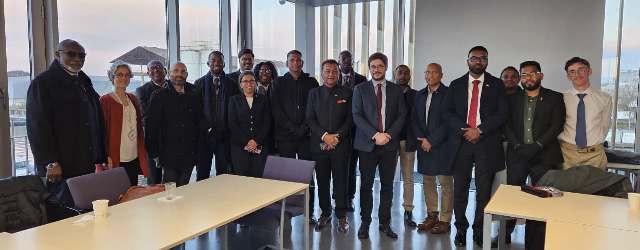
The Guyana delegation participating in the inaugural EU-Guyana Global Gateway Study and Investment Mission has returned home following a week of high-level engagements across France, Belgium, the Netherlands, and Spain. The mission, which included senior public-sector officials and leading private-sector players, explored European models in port operations, maritime governance, agro-innovation, and cold-chain logistics, areas increasingly critical to Guyana’s own development trajectory.
The delegation was led by Hon. Peter Ramsaroop, MP, Chief Investment Officer, and included representatives from the Maritime Administration Department (MARAD), the National Agricultural Research and Extension Institute (NAREI), the Guyana Office for Investment (GO-Invest), and private-sector bodies linked to ports and agro-processing, inclusive of the Guyana Manufacturing and Services Association (GMSA), Private Sector Commission (PSC), UMAMI, DDL, Banks DIH, Cranes Guyana Inc., VEHSI, and Guyana Port Inc.
The delegation also benefitted from diplomatic representation led by H.E. Sasenarine Singh, Ambassador of Guyana to Belgium and Permanent Representative to the European Union and the Organisation of African, Caribbean and Pacific States (OACPS).
Participation from the EU Delegation to Guyana added significant value, with Mr. Joan Nadal, Head of Cooperation, and Ms. Charlotte De Grauwe, Programme Officer, accompanying the mission. From the EU Delegation in Barbados, Ms. Mariana Arias, Programme Officer, also joined the delegation, while Ms. María Jesús Blanco, Project Manager and her team from FIAP (Fundación para la Internacionalización de las Administraciones Públicas), supported programme implementation and logistics throughout.
Additionally, the mission incorporated a regional Caribbean dimension, with the participation of Mr. Darwin Telemaque, CEO of the Antigua Port Authority and Chairman of the Port Management Association of the Caribbean (PMAC); Mr. Allister Mounsey, Senior Economist and Technical Expert from the CARICOM Private Sector Organisation (CPSO); and Mr. Clyde Ian Griffith, Officer-in-Charge, Plant Quarantine Unit, Ministry of Agriculture of Barbados. Their involvement reinforced the potential regional benefits of future port and agro-logistics cooperation.
Several of the mission’s most intensive sessions focused on European port operations, particularly the ports of Antwerp-Bruges, Rotterdam, Fos-Marseille, Málaga, and Algeciras. Delegates observed advanced digitalisation systems, including Port Community Systems (PCS), green transition policies, integrated cruise–cargo operations, and cold-chain logistics.
In Brussels, the delegation held policy-level engagements at the European Commission, chaired by the Directorate-General for International Partnerships (DG INTPA) and DG AGRI, examining EU investment and regulatory frameworks relevant to port development and agri-food trade under the Global Gateway strategy. European private-sector engagements were also facilitated through chambers of commerce and maritime associations.
The exposure comes at a critical moment as Guyana progresses its own plans for establishing a modern port act aimed at transforming its maritime legal framework to meet international standards and support the country’s fast-expanding logistics and trade ecosystem.
Private-sector port representatives including developers advancing the deep-water port initiative were also able to assess best practices in terminal automation, logistics coordination, and public–private governance models.
The lessons learned during the EU mission are expected to translate directly to Guyana’s port operators, even as they seek to expand facilities and accommodate new commercial shipping clients, providing practical guidance on port access, operational flow, and international best practices. Insights from modern European ports can inform the development of new port projects, supporting efficient design, coordinated governance, and streamlined operations. Similarly, knowledge gained from European authorities and industry partners can help strengthen shipyard operations, maintenance, shipbuilding, and dredging activities, enhancing both capacity and competitiveness.
The agriculture-specific leg of the mission included detailed technical exchanges at Wageningen University & Research in the Netherlands and IFAPA Campanillas in Spain. Sessions covered next-generation shade-house systems, agrivoltaics, climate-resilient farming, and smart water management. These lessons align with ongoing national efforts, especially through NAREI, to expand protected agriculture and introduce controlled-environment farming techniques.
Private-sector agro-processors on the mission were particularly focused on shelf-life extension, SPS compliance, energy-efficient processing, and cold-chain techniques that can support greater export volumes. Representatives noted opportunities to apply technologies that lengthen the life cycle of perishables, an important step for penetrating distant markets.
Further, at the Port of Algeciras in Spain-recognized as Europe’s most efficient port, the delegation examined advanced cold-chain logistics and temperature-controlled systems that support large-scale movement of fresh and frozen goods. These insights are expected to inform Guyana’s ongoing work on cold-storage solutions and export-readiness initiatives, particularly within the agro-processing sector.
Hon. Ramsaroop emphasized that the mission was designed to collect practical insights, build relationships, and identify realistic areas of future cooperation.
“This was a study and investment mission, not a negotiation mission. Our goal was to understand the systems that can help Guyana modernize its ports, strengthen agriculture, and expand exports. We now have clearer direction on where we can adapt global best practices to our local context.”
He added that the delegation’s diversity, spanning port operators, agro-processors, shipping companies, and public-sector agencies ensured that the lessons learned can be examined from multiple angles once discussions continue at home.
He further noted that continued technical collaboration under the EU’s Global Gateway Investment Agenda now provides a strong basis for future cooperation, capacity building, and potential investment partnerships to support Guyana’s growing role in global trade and food.