
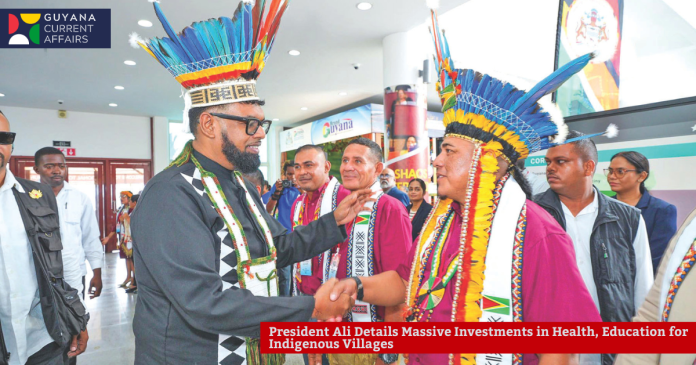
President Dr. Irfaan Ali has reaffirmed the government’s deep commitment to the advancement of Guyana’s Indigenous communities, highlighting that billions of dollars have been invested in recent years to transform health, education, infrastructure, and economic opportunities across the hinterland and riverine regions.
Speaking at the opening of the 2025 National Toshaos Council (NTC) Conference, President Ali addressed Indigenous leaders from across the country, offering a detailed, region-by-region account of the government’s targeted investments. He emphasized that these efforts are not only about development, but also about unity and empowerment, ensuring that every Amerindian village benefits from the country’s progress.
Healthcare Transformation
President Ali pointed to substantial upgrades in the health sector, particularly in Regions One and Seven. In Region One (Barima/Waini), the government’s investments have led to improved healthcare delivery and a reduction in diseases such as malaria. In Region Seven, over 45 new forms of transportation have been provided for medical staff and patients, and the availability of drugs and medical supplies has soared from less than 45% in 2019 to 85% in 2024. Health outreaches have expanded dramatically, with over 9,000 patients benefiting in 2024 alone, compared to just 1,500 in 2020. Plans are underway for a state-of-the-art hospital at Bartica and the training of more nurses to further strengthen healthcare in the hinterland.
Region Nine (Upper Takutu-Upper Essequibo) has also seen remarkable progress, with a drastic reduction in the need to transfer critical pregnant patients out of the region—from 90% to just 2%. The soon-to-be-completed Lethem Regional Hospital will feature modern surgical theaters, CT scans, a new pharmaceutical bond, and a medical school for training healthcare professionals locally.
Education and Capacity Building
Education has been another area of transformative investment. President Ali reported that as of December 2024, 83% of all teachers in Regions 1, 7, 8, and 9 were fully trained, a dramatic rise from less than 43% in 2020. The number of trained teachers recruited from Indigenous communities has increased by over 318%, with 2,435 hinterland teachers now serving in their own villages. Over the past four years, 79 new hinterland schools have been built and 27 renovated, with 54 more—including 16 secondary schools—currently under construction. Additionally, 158 hinterland schools are now connected to high-speed internet, bridging the digital divide for Indigenous students.
Infrastructure and Security
The government has also invested heavily in infrastructure, including roads, bridges, and community facilities, to enhance connectivity and quality of life. Recognizing the importance of security in remote areas, President Ali announced the issuance of 250 firearm licences to Indigenous villages, aimed at protecting communities and supporting traditional livelihoods like farming and hunting.
Economic Empowerment and Land Rights
Billions have been allocated for economic empowerment through the Amerindian Development Fund and Presidential Grants, supporting sustainable livelihoods, small business development, and land titling. The Community Service Officer (CSO) programme has been reinstated, with over 2,700 young people once again employed to serve their communities. The government has also resumed the Indigenous Land Titling Programme, demarcating an additional 15 villages since returning to office.
Unity and Progress
President Ali urged Indigenous leaders to focus on unity as the foundation for progress, countering divisive rhetoric with a message of love and collective advancement. “Together, we shall rise. Together, we are stronger. Together, we are better,” he declared, calling on the Toshaos to work with the government to develop and implement holistic plans for the future.
NTC Chairman Derick John echoed these sentiments, acknowledging the tangible benefits and resources now reaching Indigenous communities and encouraging leaders to let good sense and experience guide their decisions.
The 2025 National Toshaos Council Conference continues this week, with closed-door consultations designed to address the unique needs and aspirations of Guyana’s Indigenous peoples.