
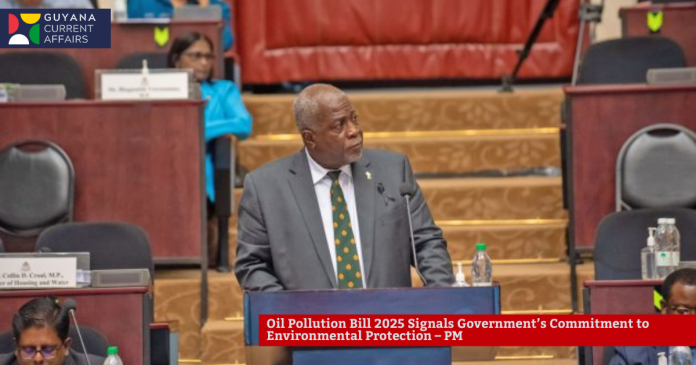
The Government has taken a decisive step to safeguard Guyana’s environment with the passage of the Oil Pollution Prevention, Preparedness, Response, and Responsibility Bill 2025, a landmark piece of legislation designed to address the growing risks posed by the country’s rapidly expanding oil and gas sector.
Prime Minister Mark Phillips, who tabled the bill in the National Assembly, described it as “an essential piece of legislation” that fills significant gaps in Guyana’s legal framework for oil spill preparedness and response. He emphasized that the bill is vital for protecting both the country’s ecosystem and its economy, aligning with international best practices to ensure that all operators in the sector bear full responsibility for environmental protection.
The new law establishes a comprehensive national framework to prevent, prepare for, and respond to oil spills. It mandates strict safety protocols, requires operators to maintain robust financial guarantees, and enforces accountability through substantial penalties for non-compliance. The Civil Defence Commission (CDC) is designated as the national authority responsible for coordinating spill response and mitigation, supported by a formalized National Oil Spill Committee tasked with regular training and readiness drills.
A key feature of the legislation is its “polluter pays” principle, placing the burden of restoration and compensation squarely on those responsible for any spill. The law empowers affected citizens and communities to seek redress for damages, and it enables the Environmental Protection Agency to instruct responsible parties to restore the natural environment following an incident.
The bill’s passage comes amid fierce debate, with opposition members criticizing it as duplicative and insufficiently stringent. However, government ministers have defended the legislation as both visionary and progressive, noting that it draws on successful models from leading oil-producing nations and addresses local concerns over disaster preparedness, liability, and compensation.
The Oil Pollution Bill 2025 is part of a broader government agenda to modernize Guyana’s petroleum sector and reinforce its commitment to sustainable development. With the country poised to become a major offshore oil producer, the new law is seen as a crucial safeguard for the nation’s environment and a clear signal of the administration’s determination to balance economic growth with environmental stewardship.