
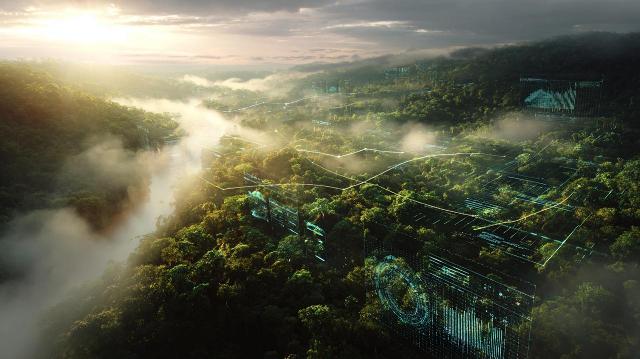
Guyana’s pioneering work in applying digital innovation and artificial intelligence to forest conservation took center stage at COP30 in Belém, Brazil, during a high-level panel discussion titled “Live Canopy: Harnessing AI and Digital Innovation for Forest Conservation and Reforestation.” The event was hosted by the Tony Blair Institute for Global Change (TBI) and convened leading experts to explore how digital technologies are transforming forest management, monitoring, and reforestation across the Global South.
The panel featured global voices on forest and AI, including André Aquino from Brazil’s Ministry of Environment and Climate Change, Pradeepa Bholanath from the Ministry of Natural Resources of Guyana, Tasso Azevedo, Coordinator of Mapbiomas, and Raul Protázio Romão, Secretary for Environment and Sustainability of the State of Pará. The session was moderated by Fabro Steibel, Executive Director of the Institute for Technology and Society of Rio de Janeiro (ITS Rio).
Guyana showcases leadership in forest data and AI integration
Representing Guyana, Pradeepa Bholanath highlighted the country’s progress under President Dr. Irfaan Ali’s priority programme on digital innovation, which integrates AI-enabled biodiversity monitoring tools into forest management and conservation systems.
Bholanath showcased how Guyana is leveraging data from digital platforms to expand its Measurement, Reporting, and Verification (MRV) system through wall to wall mapping using satellite data, traditionally used for carbon and forest cover monitoring, to now include biodiversity indicators. She explained that this system has now produced 15 consecutive years (since 2009) of monitoring using digital innovation and the sector is at the cutting edge of technological applications such as satellite imagery analysis and cloud-based processing to inform MRV reporting.
These innovations ensure that forest and climate data directly inform public policy and strengthen evidence-based decision-making, while also creating opportunities for communities to benefit from technological progress. “Guyana’s approach demonstrates how small states can lead globally by embedding technology within sustainable forest governance and how this then leads to generating climate finance” Bholanath noted, emphasizing the alignment between digital transformation and the country’s Low Carbon Development Strategy (LCDS 2030).
Technology and collaboration at the heart of forest management
The discussion, structured in two rounds, explored how AI and digital technologies can accelerate forest management and conservation, strengthen cross-sector collaboration, and ensure that innovation generates benefits for local and Indigenous communities. Speakers stressed the importance of governance, transparency, and sustainable financing mechanisms to scale up technology-driven conservation.
Panelists also emphasized the need for partnerships between governments, civil society, and research institutions to ensure that digital innovation supports equitable, long-term outcomes for people and ecosystems alike.
South-South Collaboration for Climate Resilience
The Live Canopy session underscored the growing importance of South-South collaboration in advancing AI and digital sustainability. By showcasing leadership from countries like Guyana and Brazil, the panel demonstrated how emerging economies are shaping the global conversation on digital transformation for environmental resilience.
“Artificial intelligence has become a powerful ally in managing and conserving our forests and biodiversity,” said Bholanath. “By combining innovation, inclusivity, and strong governance, nations like Guyana are setting an example for sustainable digital progress in the Global South.”
A Vision for Digital Sustainability
As COP30 continues to highlight solutions for climate and biodiversity challenges, Guyana’s experience stands out as a model for integrating AI, data, and governance to achieve sustainable forest management. The country’s commitment to digital transformation reflects a broader vision of using innovation not only to sustainably manage and conserve its vast forests but also to create knowledge-driven pathways for economic growth, environmental stewardship, and community empowerment.
Global experts on forests and artificial intelligence share perspectives during the Live Canopy session at COP30 in Belém, Brazil. From left: André Aquino, Ministry of Environment and Climate Change, Brazil; Pradeepa Bholanath, Ministry of Natural Resources, Guyana; Tasso Azevedo, Coordinator of MapBiomas; The discussion was moderated by Fabro Steibel, Executive Director of the Institute for Technology and Society of Rio de Janeiro (ITS Rio).