
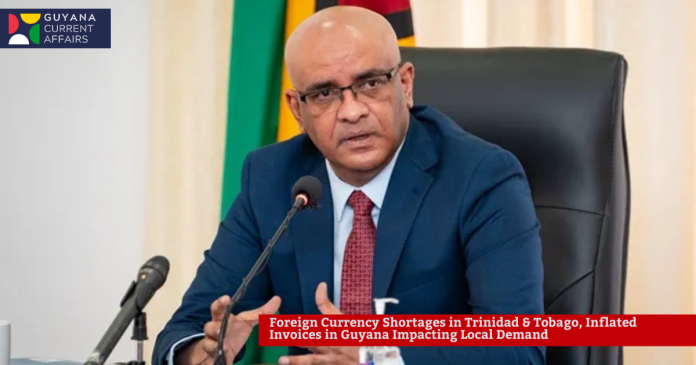
Foreign currency shortages in Trinidad and Tobago and the emergence of inflated invoices in Guyana are creating significant challenges for businesses and consumers, reshaping local demand and economic stability across both countries.
Trinidad and Tobago: Forex Shortages Disrupt Business and Consumer Activity
Trinidad and Tobago is grappling with a persistent shortage of foreign exchange (forex), a crisis that is impacting businesses of all sizes and sectors. The Trinidad and Tobago Chamber of Industry and Commerce’s recent report highlights systemic issues and policy gaps that have led to widespread operational challenges. Businesses, especially small and medium-sized enterprises (SMEs), are struggling to access the foreign currency needed for imports and international transactions, resulting in delays, increased costs, and declining profitability.
Surveys show that more than 62% of businesses face delays in paying suppliers, while nearly 60% report declining profits due to forex shortages. Only a small fraction of businesses are able to meet their full forex requirements through commercial banks, forcing many to turn to unregulated markets where foreign currency trades at premium rates. These shortages not only disrupt supply chains and hinder the importation of goods, but also increase costs for consumers and limit access to essential products.
The shortage is attributed to a combination of declining export earnings, particularly from the energy sector, and structural inefficiencies in the forex allocation system. The Central Bank’s managed float regime has not been able to keep up with demand, leading to further delays and uncertainty for businesses and individuals alike.
Guyana: Inflated Invoices Undermine Confidence and Local Demand
In Guyana, the issue of inflated invoices-particularly in the oil sector-has come under scrutiny. A recent high-profile case involved a customs declaration for oil-well equipment imported on behalf of ExxonMobil Guyana, where the value was reportedly inflated from about US$4.4 million to over US$12 billion. The Guyana Revenue Authority (GRA) is taking legal action, and the government has called for a review of past invoices to ensure transparency and accountability.
These inflated invoices have broader implications. Under Guyana’s production sharing contract with ExxonMobil, the government receives its share of oil profits only after costs are deducted. Inflated costs reduce the profit share available to the country, directly impacting national revenues and, by extension, local demand and public spending. The controversy has raised concerns about the integrity of cost claims and the need for rigorous auditing and oversight of major projects.
Regional Impact: Local Demand Under Pressure
Both issues-forex shortages in Trinidad and Tobago and inflated invoices in Guyana-are constraining local demand. In Trinidad and Tobago, businesses face higher costs and uncertainty, leading to reduced imports, supply shortages, and increased prices for consumers. In Guyana, concerns over cost inflation in the oil sector threaten public confidence and could limit the government’s ability to invest in social and economic programs that drive demand.
These developments underscore the need for policy reforms, stronger regulatory oversight, and greater transparency to restore stability and foster sustainable growth in both economies. As regional leaders and stakeholders seek solutions, the impact on local demand and economic resilience remains a critical issue for the months ahead.