
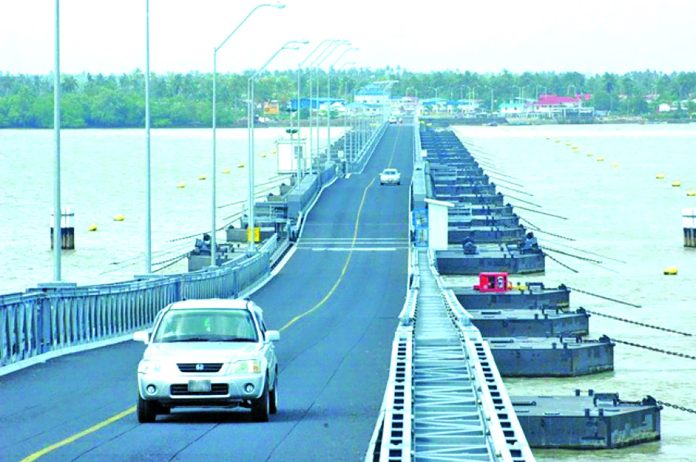
Toll-Free Announcement for Berbice Bridge
The Berbice Bridge will officially become toll-free for all vehicles, vessels, and freight starting August 1, 2025. This announcement was made by President Dr. Irfaan Ali in March, indicating that tolls would be eliminated for several bridges, including the Berbice Bridge. The Berbice Bridge Company Incorporated confirmed this transition through a public notice on Wednesday.
This significant change follows a prior announcement regarding toll-free travel across the Demerara Harbour Bridge and the Mackenzie-Wismar Bridge in Linden. The Berbice Bridge is the first to officially implement the toll-free policy, with expectations that the Demerara Harbour Bridge and Wismar Bridge Corporations will soon follow suit.
To facilitate this transition, the Berbice Bridge will close briefly for 30 minutes, from 23:30 on July 31 to midnight on August 1. Despite the removal of toll fees, traffic management and safety protocols will still be enforced at the toll booths, ensuring orderly processing of vehicles. It’s important to note that vehicle weight limits and existing operational rules for the bridge will remain unchanged.
Importance of the Berbice Bridge
Constructed between 2006 and 2008 through a public-private partnership at an estimated cost of $8.2 billion, the current Berbice River Bridge serves as a crucial connection between Regions Five (Mahaica-Berbice) and Six (East Berbice-Corentyne). The funding for the bridge came from various sources, including loans and equity contributions from the State-run National Insurance Scheme (NIS) and private investors.
Quality of Life Improvements
President Ali emphasized that these infrastructural improvements will enhance the quality of life for residents, leading to increased disposable income and better access to health and education services. He highlighted the contrasting investments in education between the current PPP/C Government and the previous A Partnership for National Unity/Alliance For Change (APNU/AFC) Government.
“Between 2015 and 2019, less than 20 percent of textbooks were available in the education system. Today, we have nearly 90 percent availability in schools. These results may not be visible in physical structures, but they are evident in our children’s outcomes,” the President stated.