
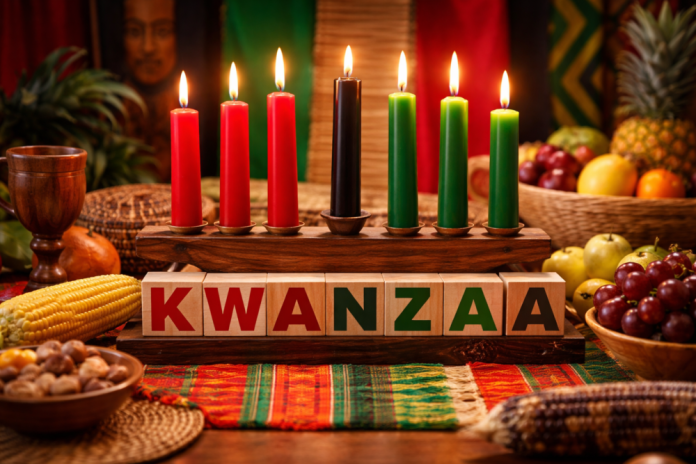
Kwanzaa, a celebration born out of struggle and hope, unfolds each year from December 26 to January 1 as a powerful affirmation of unity, culture and collective purpose among people of African descent. Observed in homes, community centres and public spaces around the world, the week-long cultural observance calls participants to reflect, reconnect and recommit to values that strengthen families, uplift communities and honour a shared heritage rooted in Africa.
This year’s celebration is marked under the theme “Practicing the Seven Principles in Dimly-Lit Times: Lifting Up the Light, Hurrying the Dawn”
Kwanzaa is not a religious holiday but a cultural one. It was created in 1966 by scholar and activist Dr. Maulana Karenga in the United States, following a period of social upheaval marked by the Watts Rebellion in Los Angeles. Dr. Karenga introduced Kwanzaa as a means of cultural grounding and renewal, drawing inspiration from traditional African harvest celebrations. The name “Kwanzaa” comes from the Swahili phrase matunda ya kwanza, meaning “first fruits,” symbolising gratitude, community and continuity.
At the heart of Kwanzaa is the Nguzo Saba, or Seven Principles, which guide the observance and are each highlighted on a specific day. Families and communities gather daily to light candles on the kinara, engage in discussion, storytelling, music and reflection, and examine how these principles can be practiced in everyday life.
The celebration begins with Umoja (Unity) on December 26, emphasizing togetherness within the family, community, nation and people as a whole. Participants are encouraged to foster harmony and mutual responsibility.
December 27 is dedicated to Kujichagulia (Self-Determination), focusing on the right and responsibility to define, name and speak for oneself, and to shape one’s own destiny.
On December 28, Ujima (Collective Work and Responsibility) calls on individuals to work cooperatively to solve shared problems and to uplift one another.
The fourth day, Ujamaa (Cooperative Economics) on December 29, highlights the importance of building, supporting and sustaining businesses and economic practices that benefit the community collectively.
December 30 marks Nia (Purpose), encouraging participants to develop and pursue goals that contribute to community development and the restoration of cultural dignity.
The sixth day, December 31, is Kuumba (Creativity), often marked by cultural performances, art, music and communal gatherings. Participants are encouraged to use creativity to leave their communities stronger and more beautiful for future generations.
Kwanzaa concludes on January 1 with Imani (Faith), emphasizing belief in oneself, one’s people and the righteousness of the collective struggle, reinforcing hope and confidence in the future.
Throughout the week, participants are expected to actively engage with the principles through reflection, dialogue and action. Common practices include pouring libations to honour ancestors, decorating with African symbols and colours, supporting community initiatives and exchanging meaningful gifts, known as zawadi, particularly with children to reinforce learning and values.
While Kwanzaa originated in the United States, it is now observed across the Caribbean, Africa, Europe and other parts of the world. Its message of unity, purpose and cultural pride continues to resonate with communities seeking affirmation, resilience and renewal.
Information on Kwanzaa’s history and principles is drawn from the writings of Dr. Maulana Karenga, the and educational resources from institutions such as the Smithsonian National Museum of African American History and Culture.